
Hair Porosity Test: How to Find Your Hair’s Porosity at Home
Have you ever applied a moisturizer or conditioner to your hair and wondered why it seems to sit on the surface instead of making your strands feel soft? Or perhaps your hair gets wet quickly but dries out again just as fast. These experiences may have something to do with your hair’s porosity.
A hair porosity test can help you understand how easily your strands absorb and retain moisture. This matters because hair that absorbs water slowly may respond differently to products than hair that takes in moisture quickly but struggles to hold onto it.
You don’t need expensive equipment to get a general idea of your hair porosity. A few simple at-home checks can help you recognize common patterns. However, not every popular test is equally reliable, so it’s important to know what the results can and cannot tell you.
What Is Hair Porosity?
Hair porosity describes your hair’s ability to absorb and retain moisture. It is closely related to the condition and structure of the cuticle, which is the outer protective layer surrounding each hair strand.
Think of the cuticle as a series of tiny overlapping scales. When these scales lie relatively flat and close together, water may take longer to enter the strand. When the cuticle is more lifted or damaged, moisture can enter more easily but may also escape faster.
Hair porosity is generally divided into three categories:
- Low porosity: Hair resists moisture absorption and products may sit on the surface.
- Medium porosity: Hair absorbs and retains moisture relatively well.
- High porosity: Hair absorbs moisture quickly but may lose it just as quickly.
Your porosity can be influenced by genetics, chemical treatments, heat styling, sunlight, and everyday wear. It can also vary between different sections of your head. For example, your roots may behave differently from older, more damaged ends.
How to Do a Hair Porosity Test at Home
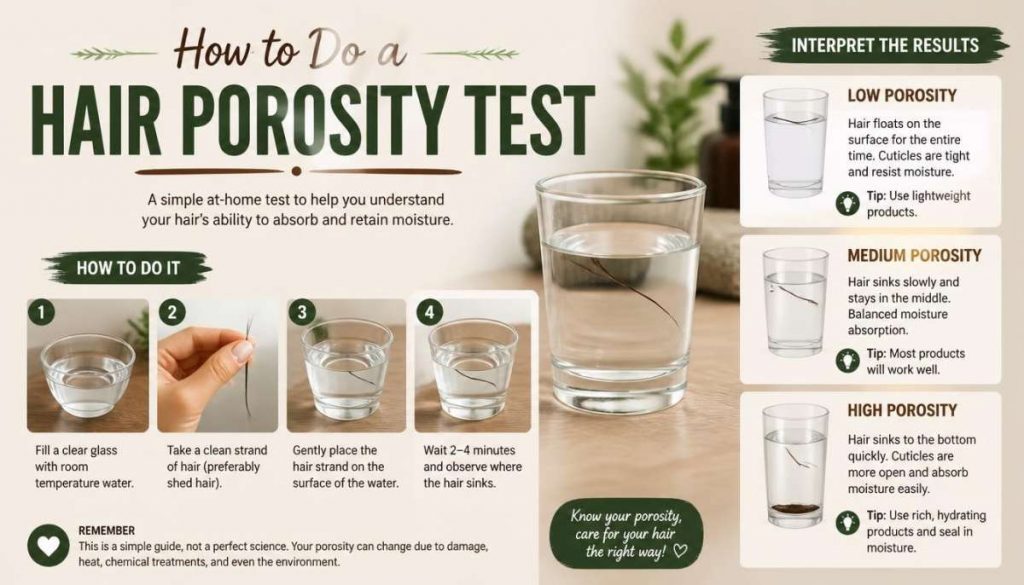
There are several ways to get an idea of your hair’s porosity without visiting a salon. Rather than relying on one observation, try combining a few simple checks.
The way your hair responds to water, how it feels between your fingers, and how it behaves after washing can provide useful clues.
1. The Spray Bottle Test
The spray bottle test helps you observe how your hair reacts when water touches it. It is simple to perform, although the results can be affected by product buildup, hair texture, and how much water you spray.
How to do it:
- Start with clean, completely dry hair.
- Avoid applying oils, leave-in conditioners, or styling products before testing.
- Separate a small section of hair.
- Lightly mist it with water from a spray bottle.
- Watch how the droplets behave and how quickly the section becomes wet.
What the results may suggest:
- Low porosity: Water may bead on the surface before gradually spreading or soaking in.
- Medium porosity: Water usually spreads and absorbs at a moderate pace.
- High porosity: Water may spread and absorb quickly.
Don’t judge your entire head of hair from one spray. Repeat the test on a few sections, especially the roots, middle lengths, and ends.
2. The Strand Slide Test
The strand slide test is another quick way to examine the surface feel of your hair. It involves running your fingers along an individual strand to notice whether it feels smooth or rough.
How to do it:
- Select one clean, dry strand of hair.
- Hold it gently between your fingers.
- Place your thumb and index finger near the ends.
- Slide your fingers upward toward the roots.
- Notice whether the strand feels smooth, slightly uneven, or noticeably rough.
What the results may suggest:
- Low porosity: The strand may feel relatively smooth.
- Medium porosity: You may notice a mostly even texture with slight resistance.
- High porosity: The strand may feel rough, uneven, or bumpy, particularly if it has suffered damage.
This test is not a scientific measurement of porosity. Hair texture, natural curl pattern, split ends, and physical damage can all affect how a strand feels. Use it as an additional observation rather than a final answer.
3. The Water-Glass Test
The water-glass test is probably the most widely shared hair porosity test online. It involves placing a strand of hair in a glass of water and watching whether it floats or sinks.
It is easy to try, but there is an important limitation: the result does not reliably measure porosity on its own. Surface tension, leftover products, oils, trapped air, and the characteristics of the strand can affect how it moves through water.
How to do it:
- Wash your hair to remove styling products and excess buildup.
- Allow it to dry completely without applying any products.
- Collect a few naturally shed strands.
- Fill a clear glass with room-temperature water.
- Place the strands gently on the water’s surface.
- Observe them for around three to five minutes.
Traditional interpretation:
| What happens to the strand? | Common interpretation |
|---|---|
| Floats on the surface | Low porosity |
| Remains somewhere in the middle | Medium porosity |
| Sinks toward the bottom | High porosity |
Remember that these are traditional interpretations, not definitive results. A strand that floats does not automatically mean you have low porosity hair, and a strand that sinks does not prove that your hair has high porosity.
If the water-glass test gives you an unexpected result, compare it with how your hair behaves during regular washing and conditioning.
4. Observe How Long Your Hair Takes to Get Wet
Pay attention to your hair the next time you take a shower. Does it become fully wet almost immediately, or do you need to spend extra time working water through different sections?
This everyday observation can help you recognize possible porosity patterns.
- Low porosity: Water may take longer to spread through the hair, particularly when the strands are coated with product buildup.
- Medium porosity: Hair generally becomes wet without much difficulty.
- High porosity: Hair may absorb water quickly.
Your hair’s thickness, density, curl pattern, and styling products can also affect how quickly it gets wet. For that reason, this observation is most useful when combined with other signs.
5. Pay Attention to Drying Time
Drying time is another useful clue, although it is not a direct porosity measurement.
Notice how long your hair takes to dry naturally after washing. Compare your usual experience over several wash days instead of relying on a single observation.
- Low porosity: Hair may take a long time to dry because moisture enters the strands more slowly and can be retained for longer.
- Medium porosity: Hair often dries at a moderate, relatively predictable pace.
- High porosity: Hair may absorb water quickly and sometimes dry faster because it does not retain moisture as effectively.
Hair length, thickness, density, humidity, airflow, and the amount of water left after washing all influence drying time. A person with thick, dense hair may take much longer to air-dry regardless of porosity.
Also Read : Hair Care Routine: The Ultimate Guide to Healthy Hair
Understanding the Three Types of Hair Porosity
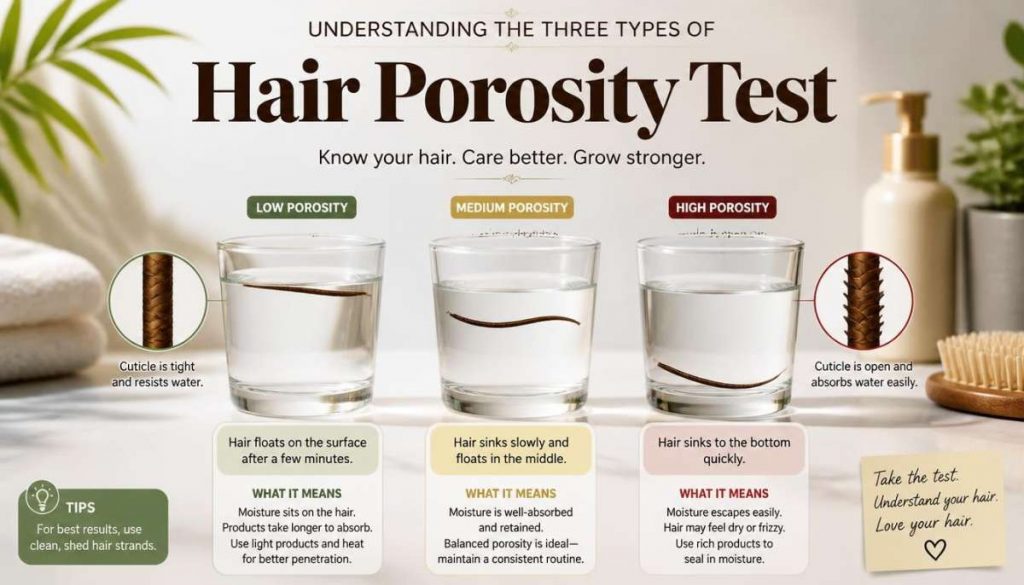
Once you have tried a few checks, the next step is understanding what the results may mean. Each porosity type has different moisture-related characteristics, which can help you choose products and adjust your routine.
Low Porosity Hair
Low porosity hair has a relatively compact cuticle layer. Water and hair-care products may take longer to penetrate the strands, which can make moisturizing feel frustrating.
You might notice that water sits on your hair before spreading, heavy conditioners leave a coated feeling, or styling products build up easily.
Common signs of low porosity hair:
- Hair takes longer to become fully wet.
- Products sometimes sit on the surface.
- Hair may take a long time to dry.
- Heavy creams and oils can leave a greasy or coated feeling.
- Product buildup may become noticeable between washes.
How to care for low porosity hair:
Choose lightweight, water-based conditioners and leave-in products. Apply them in small amounts to damp hair instead of layering several heavy products at once.
You can also try a warm shower and a conditioning cap while using a suitable deep conditioner. Gentle warmth may make conditioning more comfortable, but avoid excessive heat because it can damage the hair.
Cleanse regularly enough to prevent buildup, especially if you use several styling products. You don’t need to avoid every oil or protein product. Pay attention to how your own hair responds and adjust accordingly.
Medium Porosity Hair
Medium porosity hair generally absorbs and retains moisture without much difficulty. Its cuticle structure is relatively balanced, so it often responds well to ordinary washing, conditioning, and styling routines.
This type of hair may feel manageable without requiring special techniques to help water enter or prevent moisture from escaping.
Common signs of medium porosity hair:
- Hair becomes wet without much effort.
- Conditioner spreads relatively easily.
- Hair generally holds moisture well.
- Styling products work as expected.
- Hair often feels manageable between washes.
How to care for medium porosity hair:
Keep your routine balanced. Use a shampoo that suits your scalp, a regular conditioner, and a leave-in product if your hair needs extra softness or detangling.
Deep conditioning can be useful when your hair feels dry, but you don’t need to overload it with treatments. Limit excessive heat and chemical processing to help protect the cuticle.
Medium porosity doesn’t mean your hair can never become damaged. Regular coloring, bleaching, and frequent heat styling can change how your strands behave over time.
High Porosity Hair
High porosity hair has a more open, lifted, or damaged cuticle structure. This allows water to enter the strand easily, but moisture may escape quickly as well.
You may notice that your hair feels soft immediately after conditioning but becomes dry or frizzy again later. Tangling, rough ends, and breakage can also become concerns, particularly when the hair has been chemically processed.
Common signs of high porosity hair:
- Hair absorbs water quickly.
- Strands may dry relatively fast.
- Hair often feels dry again soon after washing.
- Frizz and tangling are common concerns.
- Hair may break more easily, especially around damaged areas.
- Color-treated hair may lose color more quickly.
How to care for high porosity hair:
Focus on conditioning, reducing damage, and helping your hair retain moisture. A nourishing conditioner, a suitable leave-in product, and a small amount of sealing oil may help reduce dryness and improve manageability.
If your hair has been bleached, colored, or exposed to frequent heat, consider a bond-building or repair treatment designed for damaged hair. Protein treatments may also help some damaged strands, but using them too often can leave certain hair types feeling stiff.
Avoid aggressive brushing, excessive heat, and unnecessary chemical processing. Regularly trimming split ends can also help prevent damaged ends from becoming harder to manage.
Low vs. Medium vs. High Porosity Hair: What’s the Difference?
The easiest way to understand the three types is to compare how they generally respond to water and moisture.
| Hair porosity | Cuticle condition | Moisture behavior | Common concern |
|---|---|---|---|
| Low | Compact and relatively flat | Absorbs moisture slowly | Product buildup |
| Medium | Relatively balanced | Absorbs and retains moisture well | Maintaining hair condition |
| High | More open, lifted, or damaged | Absorbs moisture quickly but may lose it quickly | Dryness, frizz, and breakage |
These descriptions are general patterns, not strict rules. Your hair may show a combination of characteristics, particularly if the roots and ends have different levels of damage.
Which Hair Porosity Test Is the Most Accurate?
No single at-home hair porosity test provides a perfect diagnosis. The water-glass test is popular because it is easy, but it can be misleading. The strand slide test also has limitations because roughness does not always indicate high porosity.
For a more useful home assessment, combine several observations:
- Notice how quickly your hair becomes wet.
- Observe how it responds to water from a spray bottle.
- Pay attention to how it feels after conditioning.
- Track how quickly it dries under similar conditions.
- Consider whether your hair has been colored, bleached, relaxed, or frequently heat-styled.
If these observations point in the same direction, you may have a better idea of your hair’s porosity.
For a more detailed assessment, a qualified hair professional can examine your hair’s condition and discuss its history. Remember that a professional consultation is also different from a laboratory measurement of the hair fiber.
How to Choose Hair Products Based on Porosity
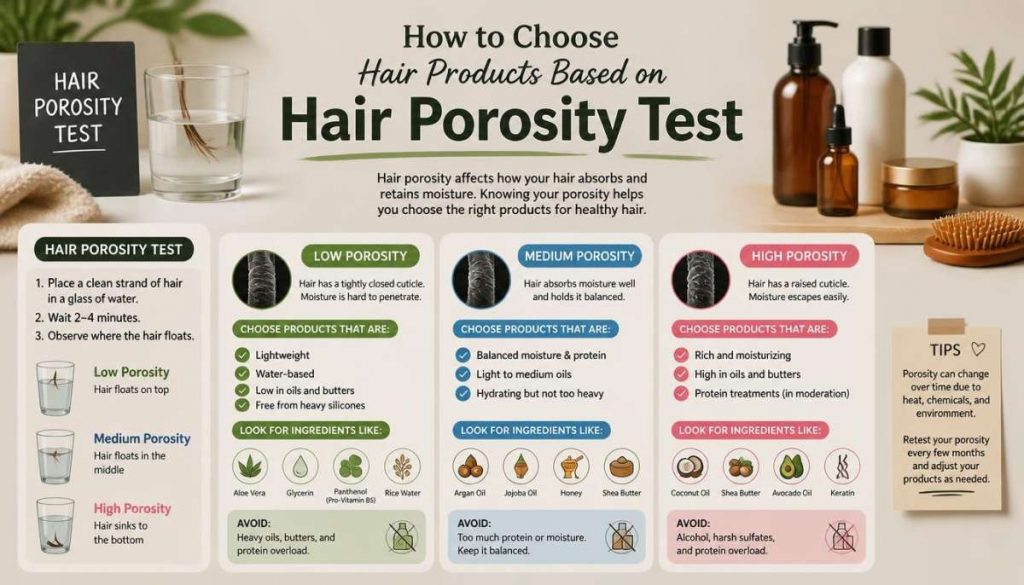
Once you understand your likely porosity, you can use that information to make better product choices. You don’t need to replace your entire collection. Start by adjusting the weight and amount of products you use.
Products for Low Porosity Hair
Low porosity hair may become weighed down by thick creams and multiple layers of oil. Try:
- Lightweight, water-based leave-in conditioners.
- Gentle shampoos that remove buildup.
- Lightweight moisturizing conditioners.
- Deep conditioners that are easy to rinse out.
- Small amounts of styling products.
Products for Medium Porosity Hair
Medium porosity hair usually works well with a balanced routine. Consider:
- A regular shampoo and conditioner.
- Moisturizing leave-in products.
- Heat protectant when using hot tools.
- Occasional deep conditioning.
- Repair treatments when your hair needs extra support.
Products for High Porosity Hair
High porosity hair often benefits from products that improve softness and help reduce moisture loss. Consider:
- Richer moisturizing conditioners.
- Nourishing hair masks.
- Leave-in conditioners.
- Lightweight sealing oils or creams.
- Bond-repair treatments for damaged hair.
The best product is the one that works with your hair’s actual needs. A product marketed for high or low porosity hair isn’t automatically suitable for everyone in that category.
Can Hair Porosity Change Over Time?
Yes, the way your hair behaves can change over time. Genetics play an important role in natural porosity, but the condition of the cuticle can be affected by everyday habits and treatments.
Bleaching, permanent coloring, chemical relaxing, frequent heat styling, UV exposure, and physical wear can contribute to cuticle damage. As the hair becomes more damaged, it may absorb water more easily and struggle to retain moisture.
This is one reason your hair may behave differently after a coloring appointment or a period of frequent heat styling.
You cannot permanently change your natural hair structure with a particular shampoo or oil. However, suitable conditioning and repair products can improve the feel, smoothness, and manageability of damaged strands.
Common Hair Porosity Testing Mistakes to Avoid
At-home tests are easy to try, but a few mistakes can lead to confusing results.
- Testing hair with product buildup: Oils, conditioners, and styling products can change how water interacts with your strands. Start with clean hair.
- Relying only on the float test: A strand’s position in water is affected by more than porosity. Don’t treat it as a final diagnosis.
- Testing only one section: Your roots, middle lengths, and ends may behave differently. Check more than one area.
- Confusing hair thickness with porosity: Fine, medium, and coarse describe strand thickness, not how easily hair absorbs moisture.
- Assuming curly hair is always high porosity: Curl pattern and porosity are different characteristics. Curly, wavy, and straight hair can all have different porosity levels.
- Buying products based on one test: Look at your hair’s overall behavior before changing your entire routine.
Frequently Asked Questions
What is the easiest hair porosity test to do at home?
The spray bottle test is one of the easiest options. Lightly mist clean, dry hair and observe how water spreads and absorbs. Combine this with other observations for a more useful estimate.
Is the water-glass hair porosity test accurate?
The water-glass test is not fully reliable. Surface tension, product residue, oils, and the characteristics of individual strands can affect whether hair floats or sinks. Treat it as a rough experiment rather than a definitive test.
How do I know if I have low or high porosity hair?
Low porosity hair generally takes longer to become wet and may resist product absorption. High porosity hair tends to absorb water quickly but may lose moisture just as quickly. Look at several signs rather than relying on one test.
Can I have more than one hair porosity type?
Yes. Different sections of your hair can have different porosity levels. For example, your roots may be relatively healthy while older ends have become more porous due to heat or chemical damage.
Is hair porosity the same as hair type?
No. Hair type usually refers to your natural pattern, such as straight, wavy, curly, or coily. Porosity describes how your hair absorbs and retains moisture. Someone with curly hair can have low, medium, or high porosity.
Does high porosity hair mean damaged hair?
Not always. Genetics can influence natural porosity, but chemical treatments, heat, and physical wear can also increase cuticle damage. High porosity hair may be more vulnerable to dryness and breakage, depending on its condition.
How often should I test my hair porosity?
You don’t need to test your hair every week. Reassess it if its behavior changes noticeably, especially after bleaching, coloring, relaxing, or frequent heat styling. Focus on how your hair responds to water and conditioning over time.